

Research Projects
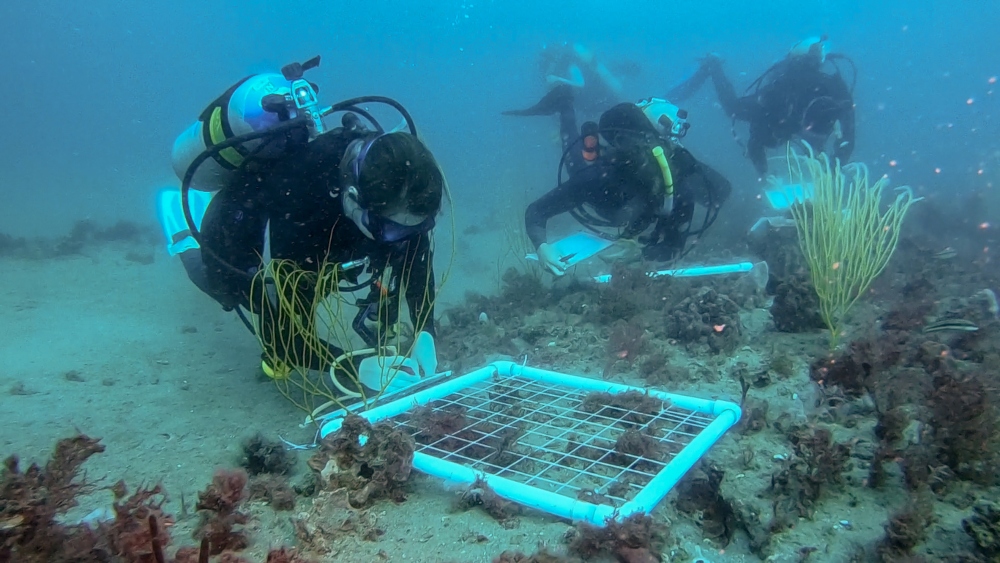
Photo: Alison Soss/NOAA
Research in Gray's Reef National Marine Sanctuary supports the management of the underwater park. Research projects have guided the sanctuary's management since the original designation in 1981.
Gray's Reef supports research projects from federal, state, and academic institutions by providing vessel support to travel to the sanctuary. The science staff of Gray's Reef actively encourages scientists and students to engage in research and monitoring efforts to aid in our understanding of this unique marine ecosystem.
Below are a few of the research areas that the sanctuary and partners are studying.
Autonomous Gliders
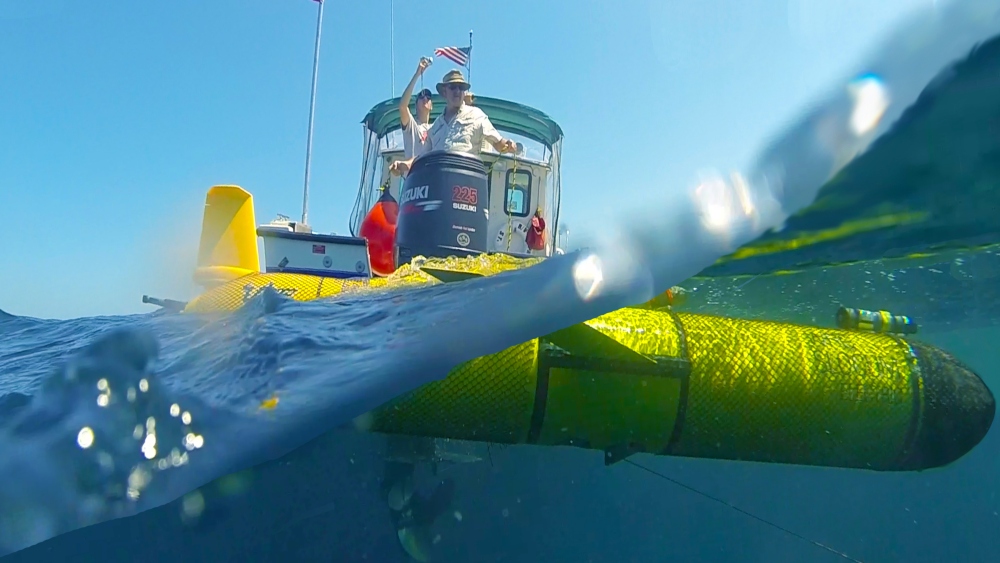
Photo: Ed Hughes/USF College of Marine Science
Gliders are autonomous underwater vehicles, or underwater robots, that have proven to be robust scientific tools for coastal ocean sampling with long range and endurance. Gliders ‘fly' through the water by changing their buoyancy and center of gravity, resulting in a yo-yo-like pattern between the surface and seafloor while their wings and rudder can change their direction.
Gliders moving in and around Gray's Reef National Marine Sanctuary often have acoustic receivers attached to them in order to collect ‘pings' from tags inside fish that were placed there by researchers. These pings allow scientists to study their movement and migration with the added support of stationary receivers located along the entire Atlantic coast.
Autonomous gliders can also be equipped with other research instruments that measure various properties of ocean currents. Currents at Gray's Reef are influenced by tides and river flow from the five coastal rivers of Georgia and gliders can sense the direction, speed, and salinity of currents.
Fish Studies
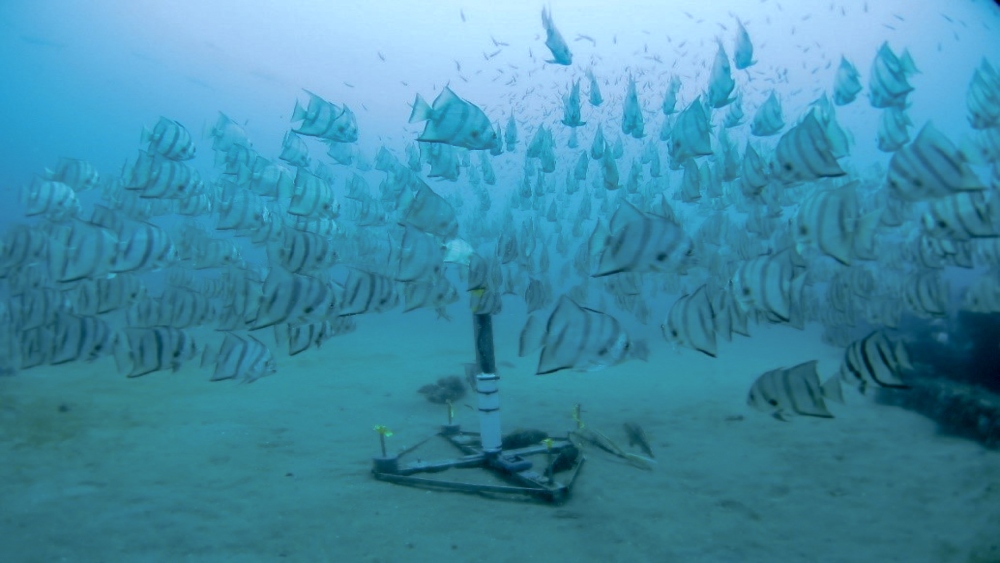
Photo: NOAA
Gray's Reef is home to a variety of recreationally and commercially important fish species. Its rocky, hard-bottom habitat attracts over 200 species of fish providing exceptional habitat for species such as cobia (Rachycentron canadum), red snapper (Lutjanus campechanus), tripletail (Lobotes surinamensis), and Atlantic sturgeon (Acipenser oxyrinchus oxyrinchus).
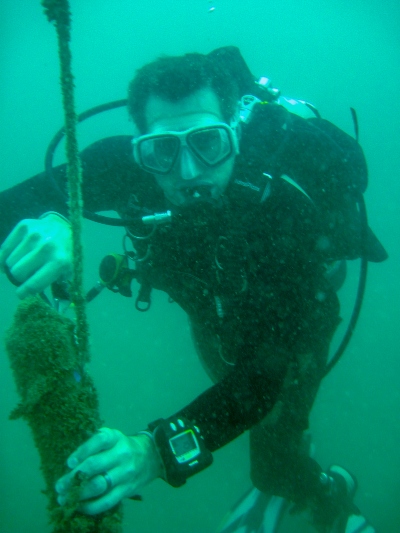
Scuba divers regularly service acoustic receivers by cleaning their outsides so
they
are
free
of algae and other ocean growth. The acoustic receivers count ‘pings' emitted by
tagged
fishes to track movement in the sanctuary.
Photo: NOAA
Monitoring and Tagging Efforts
Gray's Reef acoustic fish tagging project began in 2008 to provide important information about fish movement within the sanctuary. Acoustic tags were surgically implanted in fish to emit a unique signal detectable to acoustic receivers stationed across the sanctuary seafloor. These receivers record the date and time in which a fish is detected within the vicinity of a receiver, allowing scientists to monitor their movement and habitat preferences.
The acoustic receivers of Gray's Reef connect with a broader network of receivers in the Atlantic Ocean from as far north as Nova Scotia, Canada to as far south as the Florida Keys and Caribbean. Gray's Reef lies in the core of the geographic region encompassed by the Florida Atlantic Coast Telemetry Network (FACT) and the southern edge of the region covered by the Atlantic Cooperative Telemetry Network (ACT).
Measuring Fish Community Composition
Fish communities serve as useful biological indicators for environmental change as their health is relatively sensitive to the marine environment in which they live. Researchers at Gray's Reef are interested in understanding fish behavior, distribution, and movement within the sanctuary, as well as predator-prey interactions and fishing pressures.
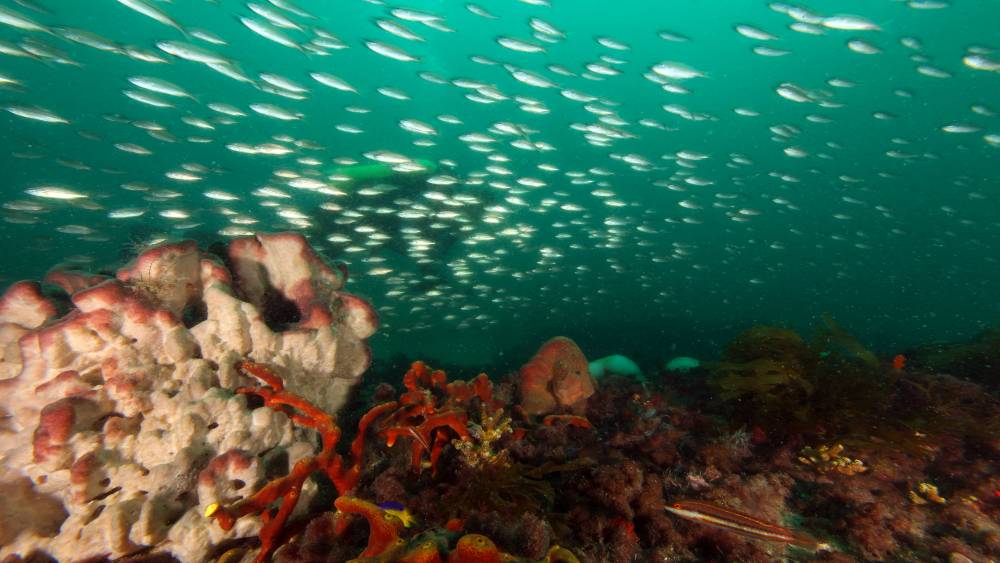
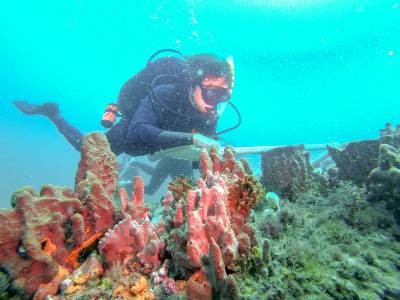
Photo: Alison Soss/NOAA
Habitat Monitoring
While Gray's Reef is predominantly known for its live-bottom habitat, only about 25% of the anctuary is hard bottom. The rest of the sanctuary is largely composed of rippled and flat sand. As one of the largest concentrated a Reef serves as an important hub or corridor of the South Atlantic Bight's ecological network, supporting a high diversity of fish and animal migration.
Marine Debris
Marine debris is a concern for Gray's Reef, a popular site for fishing and boating, as marine debris is known for accumulating in areas of high boat use. The hard-bottom habitat at Gray's Reef is also structurally complex due to its overhanging ledges, making it more prone to marine debris accumulation than other bottom habitat types. Sanctuary managers are interested in understanding the potential effects of marine debris on sanctuary resources. Knowing the types, abundance, and distribution of debris is essential to improving debris removal and education efforts.
Water and Sediment Quality
Runoff from coastal communities—and the extended reach of river watersheds—affects coastal and offshore waters and sediments, including Gray's Reef. While contaminant concentrations have been relatively low in previous years (2000, 2005, 2012/2013), contaminants have been discovered in the sediment and edible tissues of fish and shellfish species within the sanctuary. Routine monitoring continues to be conducted at Gray's Reef, both at the surface and bottom of the water column, to determine what contaminants may be present and if or when any changes may occur.
Ocean Acidification
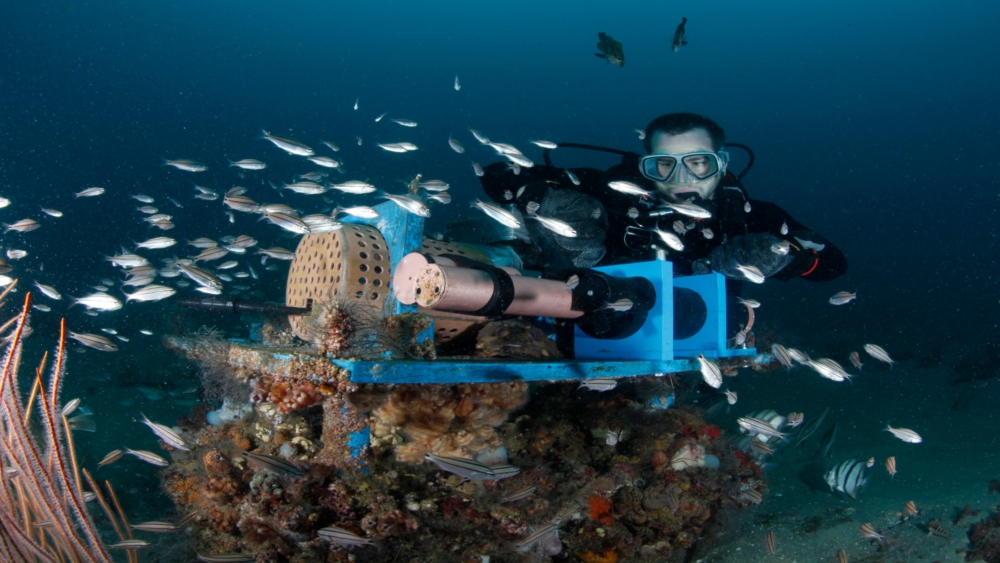
Ocean chemistry platforms, like the one shown here, measure the changing water parameters like pH, temperature, and carbon dioxide monitoring the impacts of climate change on the sanctuary. Photo Greg McFall/NOAA Alt text: A scuba diver works on a blue research platform with underwater, scientific instruments.
Ocean acidification refers to a reduction in the pH of the ocean over an extended period of time, caused primarily by increased uptake of carbon dioxide (CO2) from the atmosphere. Ocean acidification is affecting the entire world's oceans, including coastal estuaries and waterways.
More facts about ocean acidification
Monitoring Ocean Acidification
Carbon dioxide monitoring at Gray's Reef National Marine Sanctuary began in 2006 when sensors were added to the National Weather Service buoy in the sanctuary. Three sensors collect CO2 levels in the air, in surface water, and at the seafloor, making Gray's Reef a sentinel site for ocean acidification research. Since this research began, the sensors have shown that seawater CO2 is increasing faster than expected and that major storm events are associated with rapid changes in seafloor CO2.
Measuring Impacts of Ocean Acidification
From sea snails to scallops, many marine species depend on hard shells made from calcium carbonate to protect them from predators, pounding surf and other threats. Ocean acidification reduces the amount of building material, or calcium carbonate, available to animals in the ocean. That makes it harder for organisms to form their calcium carbonate shells or can cause their shells to dissolve, threatening a number of shelled marine organisms.
Predator-prey interactions using 360 video
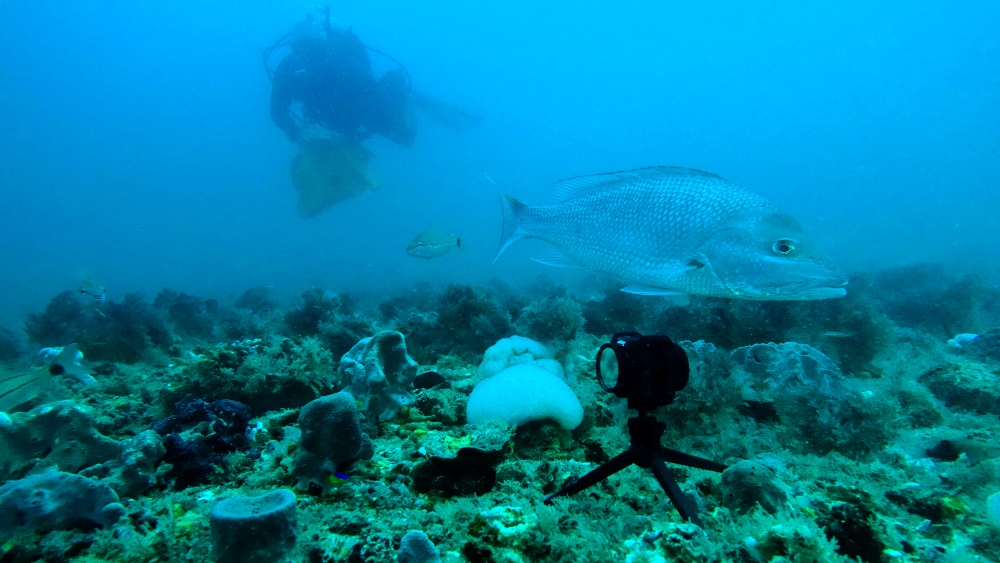
Photo: Peter Auster/University of Connecticut
Live-bottom habitats host complex behavioral and food web interactions between the benthic and pelagic zones. Managers at Gray's Reef are interested in understanding the dynamic interactions that occur within the water column. Understanding such interactions are important for predicting the effects of management alternatives related to conservation, sustainable use, and biological diversity.
Specialized 360° cameras are placed on the ocean floor while divers push the record button and swim away. The fish in the area return and act as if no scientists are near while their behavior is recorded on the camera. The footage is later analyzed by researchers to see which fish eats which. More 360° videos can be found in the Multimedia page.
Black sea bass are the most abundant predator at Gray's Reef. Their group ambush style of feeding is seen here as a school of tomtate drift over a rocky ledge. Video courtesy of Peter J. Auster/University of Connecticut funded by the National Marine Sanctuary Foundation. Alt text: Schools of fish swim over a live-bottom reef covered in fuzzy algae.
Invasives and Non-Native Species
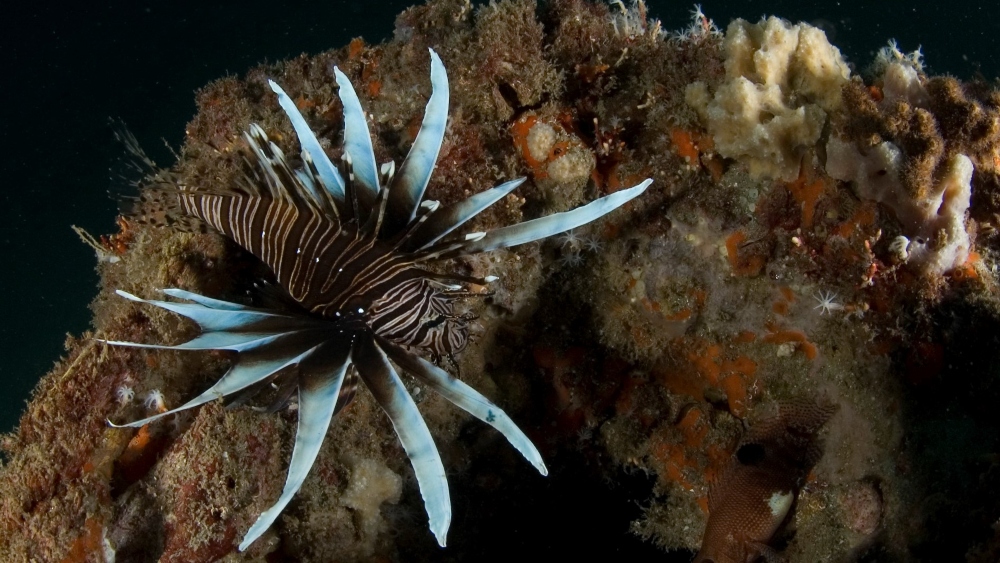
Lionfish and other invasive species have unknown consequences to the ecosystems at Gray's Reef National Marine Sanctuary. Photo: Greg McFall/NOAA Alt text: A red and white striped fish with sharp dorsal spines swims atop the rocky ledge on a reef.
Several invasive species have been sighted within Gray's Reef, including the Asian green mussel (Perna viridis), the titan acorn barnacle (Megabalanus coccopoma), the orange cup coral (Tubastraea coccinea), and the lionfish (Pterios sp.)
The first lionfish sighting occurred in 2007; however, it was not until 2012 that sightings became prevalent and lionfish were more commonly seen around the reef and live-bottom areas of the sanctuary. Researchers at Gray's Reef continue to monitor, document and remove lionfish to better understand their presence and assess their environmental impact to the sanctuary ecosystem.
Learn more about Sanctuary's efforts to control the lionfish invasion.